// Emotional domain
Memory
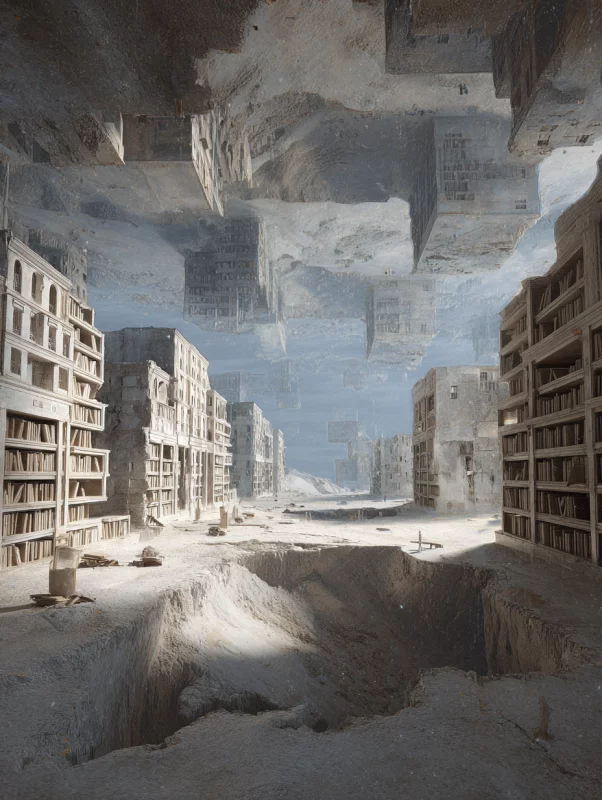
The Unstable Archive: Why No Memory Survives Identical to Itself
The Room of the Faithful Echo promises to return an exact memory, and always fails at the same point: life is missing. It is the contradiction on which the entire Domain rests — the more a memory is protected from change, the less it resembles a true memory, because memory, for neuroscientific sources as for philosophical ones, has never been a store. It is a process.
1. Rewritten at Every Recall
Research on memory reconsolidation has shown that each time a memory is recalled, its neural trace becomes temporarily unstable and is reconstructed, not simply reread. The mere act of remembering alters, to a small degree, what is remembered — and does so without the one remembering noticing.
2. Constructed, Not Recorded
Studies on reconstructive memory show that the brain does not work like a video camera: it reorganises events according to pre-existing schemas, cultural expectations and information acquired later, to the point of generating detailed memories of episodes that never happened. The distinction between a true memory and a confabulated one is not always accessible to the one living it: both, from the inside, feel equally certain.
3. What Remains of Who We Have Been
For Bergson the past is never truly past: it continues to coexist with the present as duration, colouring it without our noticing. Locke reaches a more radical conclusion, tying personal identity precisely to the continuity of memory — to lose the memory of oneself means, in a relevant sense, to lose oneself, even if the body that acts remains the same.
4. Seven Regions of Memory
The Domain never lets itself be explored twice in the same way: every step reactivates an echo, every object seems already to belong to something lived or merely imagined.
The Garden of Anachronisms makes different eras coexist on the same ground, without conflict, in a silent dissonance.
The Caves of Others' Memory hold complete events that do not belong to those who visit them — but the longer one stays, the more they seem one's own.
The Plateau of Unspoken Words keeps on improvised altars the sentences no one ever finished saying.
The Corridor of Overwriting returns the same door with a slightly different scene at each passage, corrected by present regrets and desires.
The Bubble of the Perfect Memory isolates a scene without friction or error — the sweetest memory the collector has ever had, and for that reason the least reliable.
The Museum of Disconnected Memories displays real objects stripped of their context, catalogued by an order that answers to no recognisable chronology.
The cost of reliability
In the field of courtroom testimony, research has documented how far a memory can be altered by a suggestive question, by the repetition of the account, or by the simple pressure of a group that remembers differently. This is not an occasional lapse: it is the same plasticity that makes memory useful — able to update itself, to integrate new information — that makes it, at the same moment, open to manipulation. The reliability and the instability of memory are not two properties in conflict. They are the same property, observed from opposite directions.
// Zones of the domain