- ID
- MDES-008
- Outcome
- Pending
- Compatible Bodies
- Diletta Ciurmaglia · Taro
- Zone
- Contact Greenhouse
- Domain
- Desire
// Rapporto di missione
The Contaminated Contact Greenhouse
Locate and recover the Spiral reported at the centre of the Contact Greenhouse (east sector), a hybrid Desire + Shame zone. Operate as a mixed pair while keeping the contact protocol: no unauthorised approach to the Spiral, control of the anchor-object threshold, management of the tactile amplification induced by the Zone.
Spiral recovered but compromised (stability 58%). Protocol breached: non-protocol contact by Diletta with the Spiral, extreme emotional contamination. Taro keeps the discrimination ("it's not mine") and anchors Diletta to lucidity; he recovers the Spiral himself. Both abandon their anchor objects. Dyad operationally at risk: latent affective tension amplified to critical threshold.
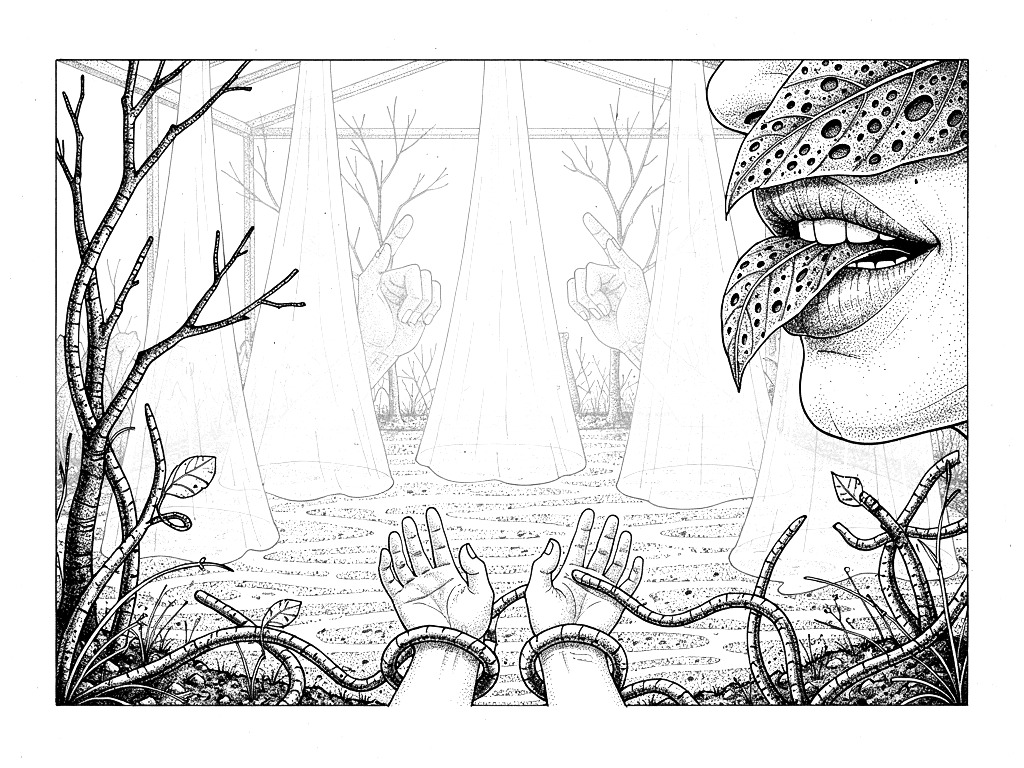
The portal opens in the archive room of sector C-14, in a narrow aisle between two shelves of discarded reports where the dust stopped settling long ago. For a few seconds there is a full silence, and the body's weight vanishes all at once, like the first step of a staircase that isn't there. Diletta goes through first, the fountain pen gripped in her left hand: her anchor object, the metal already warm against her palm. The crossing is liquid and dense, the feeling of sliding into a thought that is too warm. Taro follows three seconds later. His body resists the passage, pushing against the unstable fabric of space as if against a current, and once he is on the other side the air around him stops and settles. He has the knife wrapped in his grandmother's handkerchief, tucked into an inside pocket.
On the other side is the Contact Greenhouse, which belongs to the Domain of Desire and carries a third of Shame inside it: Desire pushes you to want, Shame holds a mirror in front of you while you want. The first thing you notice is that the air is alive. It is warm and water-saturated, and on top of that it moves on its own, against the skin, curious, insistent, always a little closer than a draft of air should be. The light comes from below and from the walls, a honey yellow that pulses slowly and leaves everything above two metres in shadow. What look like plants are actually vegetal columns as thick as tree trunks, bending toward the two bodies, with broad fleshy leaves that sway in their direction and aerial roots hanging from the dark like open fingers, waiting. The ground gives under their feet, soft and warm, beating a slow steady rhythm that can be felt rising through the ankles. Taro looks around with his knuckles white on the knife and says he has the impression the place already knows him. The air smells of earth after rain, of sap, of freshly washed skin, and of something sweet that stays unnamed.
The desire, in that zone, had already begun to move a few minutes earlier: a glance that lingered, a thought pushed to one side. Then the Shame contamination switches on. Thin translucent membranes open among the leaves and work as mirrors, giving back the two bodies deformed: she too exposed, too desiring; he too massive, too present. She shifts her eyes, and a moment later goes back to it. The mirror has done its work: the want she could still treat as a passing thought now has a face and sits there, in plain sight. From that moment, every time she looks at Taro — the neck, the shoulders, the hands on the knife — she sees skin, warmth, a possibility, and in the same instant the push to hide it, to turn away before it shows. The two things pull together, in opposite directions. The plants begin to touch, gently, almost with affection: a leaf brushes her arm, lingers, comes back to stroke it. She pulls away and the warmth stays on her skin, an echo that takes too long to fade. The path meanwhile twists back on itself, and every step opens three new directions, all inviting. Their heartbeats, on their own, fall into the same rhythm. The distance between their bodies drops below the half-span the protocol sets as the limit. Too close.
The spiral is further ahead, toward the centre, suspended between two huge trees and held still by a tangle of aerial roots. It is as wide as two hands, coiled on itself for almost four turns: liquid gold, warm silver, a pulsing pink, here and there a grey vein. The light it gives off is little use for seeing and a great deal for calling; it pulls toward itself, it promises. Taro asks her to wait, he wants to check it first. Diletta does not wait. She reaches out and brushes the surface with her fingertips, and something opens inside her: pure desire, bottomless, which for an instant shows her Taro the way the Greenhouse wants her to see him, the only thing in the world that counts. He lays his hands on her shoulders, broad and steady, barely resting there, and asks her to breathe with him counting to three. She looks into his eyes and finds one thing the Domain leaves intact: real concern, respect, a protection that is content simply to be there. And yet her senses go elsewhere: toward his mouth, which she wants and does not reach; toward her belly, which on its own seeks the contact of his. For an instant the two pulls — the one holding her and the one the Greenhouse pours over her — cancel each other out. Her fingers come away from the spiral. Her legs give, and she finds herself on her knees on the pulsing ground.
Taro crouches down beside her and stays there still, close enough for her to feel his warmth, his hands in his lap. He tells her it is the Domain talking, that this is not her, that what she feels is a graft of the Greenhouse; she answers that she knows, and that it still keeps feeling true. Then he admits it happens to him too: since they came in he has felt something for her, and he knows the Greenhouse is putting it on him, and he can keep separate what is his from what has been handed to him, and this has been handed to him. She asks him how he manages. He tells her about his grandmother, who always used to say that a thing too good to be true is either a trap or a dream, and that in dreams you don't get fed. Diletta laughs, a short strangled sound, the one loose gesture she has made since coming in.
Taro approaches the spiral with hemp gloves, takes three breaths and picks it up. It trembles in his hands with the tremor of a sick thing looking for a cure, and lets itself be lifted and wrapped in his grandmother's handkerchief, and holds together. Meanwhile the Greenhouse has closed behind them: the plants have formed a dense wall where the passage used to be, and the way back has to be found again from scratch. They walk in silence. The desire is still on both of them, thin, sticky, but now it has a name and can be carried. After nineteen minutes they find a crack in the fabric of the Greenhouse, a narrow warm gap run through by the same pulse as the ground.
In front of the portal the protocol calls for leaving the anchor objects there. Diletta has known this for years, and for a moment knowing it and doing it stay two distant things. She kneels and sets the pen on the warm soil, between two roots that cross each other. The roots move slowly, wind around the pen, draw it in until it disappears into the fabric of the Greenhouse. Taro opens the handkerchief, takes out the knife and lays it next to the pen, and the roots take that too, with the same calm. Then they go through the portal, one after the other. The way out burns less than the way in and hurts more.
They land in the archive room, in the same spot they left from, fifty-eight minutes heavier and with empty hands. Diletta closes her left hand on a weight that isn't there and still feels the pen pressing against her palm. Helena is waiting for them with the stopwatch in her hand; she takes the spiral wrapped in the handkerchief, the only thing to come out of the Greenhouse, weighs it, smells it, and says it is contaminated but can be recovered, that Ambrogio will assess it. She orders twenty-four hours of separate quarantine and no word about the mission until then, and she watches them a long while before letting them go, as if she is still deciding whether to believe it. The hardest work of that day came after the entry, when it was a matter of keeping distinct — inside a place built on purpose to muddy the water — a feeling of one's own from one handed over from outside: the same effort that falls, far from there, to anyone who has ever mistaken for love the coincidence of an evening, a room, a closeness that came about and was not chosen.
// Rapporto integrale
▸ Rapporto Lucilla 2.0 — dossier integrale (PDF)
// Related records